Biological Activity and Molecular Docking of 2-(3-Aryl)-1, 2, 4-Oxadiazol-5-yl)acetonitrile: Potential Antibacterial Agent Acting on Carbapenem Enzyme
Aldiceia Luiz de Moura

Departamento de Química/Programa de Pós-Graduação em Química, Universidade Federal Rural de Pernambuco, 52171-900, Recife-PE, Brazil.
Frederico José de Santana Pontes
Leeds Institute of Cardiovascular and Metabolic Medicine, School of Medicine, University of Leeds, Leeds, UK.
João Rufino de Freitas Filho
*
Departamento de Química/Programa de Pós-Graduação em Química, Universidade Federal Rural de Pernambuco, 52171-900, Recife-PE, Brazil.
Jucleiton José Rufino de Freitas
Unidade Acadêmica do Cabo de Santo Agostinho, Universidade Federal Rural de Pernambuco, 52171-900, Recife-PE, Brazil.
*Author to whom correspondence should be addressed.
Abstract
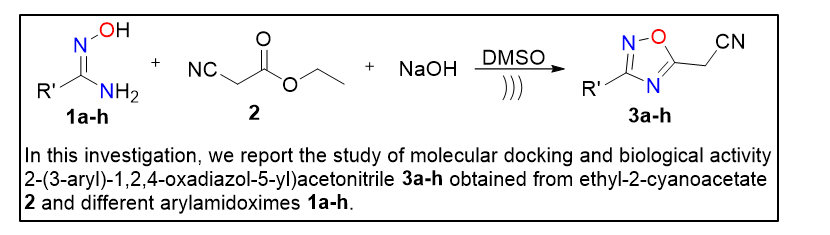
In this investigation, we report the study of molecular docking and the biological activity of 2-(3-aryl)-1,2,4-oxadiazol-5-yl)-acetonitrile 3a-h obtained from ethyl-2-cyanoacetate 2 and different amidoximes. The obtained compounds were screened for in vitro antimicrobial activity against different strains, during which compounds 3c and 3f showed potent antimicrobial behavior against bacteria Staphylococcus aureus, Enterococcus faecalis, and K. pneumoniae. Regarding antifungal activity, compound 3f also showed better results against the fungi Candida utilis and Candida albicans, with an IC50 of 312.5 μg/mL. On the other hand, when tested for in vitro antitumor activity, compounds 3f and 3g showed better inhibition power with a CC50 of 50.12 μg/mL for Caco-2 (Caucasian colon adenocarcinoma) and a CC50 of 37.64 μg/mL for Caco-2 (Caucasian colon adenocarcinoma), respectively. Oxadiazole compounds interact with receptors through cation-π, π-π stacking interactions, and, in the case of 1,2,4-oxadiazoles, hydrogen bonds. To determine the potential mode of action of the compounds, a molecular docking investigation was conducted. The molecular docking study was performed for four biological targets, PDB 4CJN (Staphylococcus aureus), PDB 6 MKI (Enterecoccus falaelis), PDB 2OV5 (Klebsiella pneumonial) and PDB 6l13 (Pseudomonas aeruginosa), the results were quite promising, highlighting compound 3g (2-(3-(4-bromophenyl)-1,2,4-oxadiazol-5-yl)acetonitrile) which showed lower binding energy for 4CJN, 6MKI and 6I13 receptors with values of -8.02, -6.72 and -7.96 kcal/mol, respectively. In this work, we examine through molecular docking and atomistic molecular dynamics how interatomic interactions between oxadiazoles and proteins explain biological activity.
Keywords: 1,2,4-oxadiazoles, molecular dynamics, molecular docking, binding energies, biological activity